
Every year, rural and peri‑urban intersections become accident hotspots during cold winter months, largely driven by reduced night‑time visibility. Standard metal traffic signs can merge into dark wooded backgrounds after sunset, while painted road markings get rapidly obscured by mud, slush and fresh snowfall. One recurring technical question that frequently comes up for municipal engineering teams is: What usually causes blurry edges of projected patterns? Many safety‑focused road‑projection projects fail to deliver expected warning performance not because of insufficient brightness, but from soft, fuzzy pattern edges that make critical traffic symbols hard for drivers to recognise at speed.
A local municipal authority was dealing with persistent hazards at a high‑risk railway crossing and road intersection. On dark freezing winter nights, inattentive motorists often failed to notice advance hazard alerts, creating serious risks close to the rail line. Conventional signage and road paint could not meet site requirements; snow cover and storm water would render them ineffective. The department needed a weather‑resistant warning solution that would not get buried under snow or washed away by harsh weather. At the same time, engineers were concerned about the common pitfall: blurry projected pattern edges. Soft, unfocused “STOP” graphics on asphalt would defeat the whole purpose of safety projection — drivers travelling at road speeds require crisp, well‑defined outlines to process warning information in split seconds.
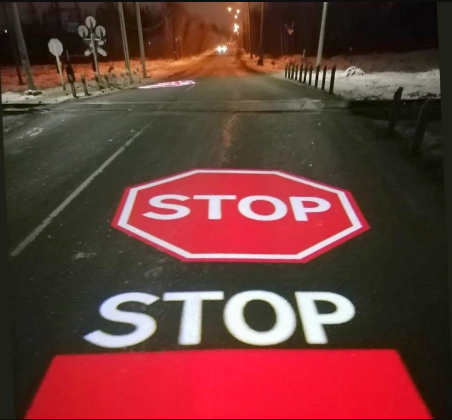
To solve both the safety hazard and the risk of degraded projection clarity, the municipal engineering team selected Noparde heavy‑duty outdoor road safety projector systems. Unlike passive reflective roadside signs, these units cast high‑intensity light directly onto asphalt surfaces, actively displaying traffic warnings within drivers’ primary field of view.
On‑site installation projects a large glowing red octagonal “STOP” symbol alongside sharp white “STOP” text straight onto vehicle travel lanes. Now we address the core question: What usually causes blurry edges of projected patterns? In outdoor roadside deployments, multiple factors work together to erode image sharpness. Misaligned or low‑quality optics, dirt, slush and ice adhering to the projector lens, improper focus adjustment, large throw distances paired with mismatched lens selection, and thermal deformation caused by extreme freezing or fluctuating temperatures all contribute to soft, smeared pattern borders. On wintry road sites, road‑salt mist and splashed slush accumulate on optical surfaces, which is one of the most frequent real‑world triggers for blurred edges for outdoor road safety projector hardware.
Well‑positioned projected road warnings naturally capture driver attention far better than pole‑mount static signs, as the warning sits directly within the natural line of sight of approaching traffic. Even with snow piled along road verges and sub‑zero ambient temperatures, the high‑output LED source cuts through darkness, presenting a highly‑visible safety beacon on damp, frost‑dusted pavement. However, brightness alone is not enough. If pattern edges turn soft and indistinct from lens contamination or poor optical matching, even powerful light output cannot guarantee safe driver recognition.
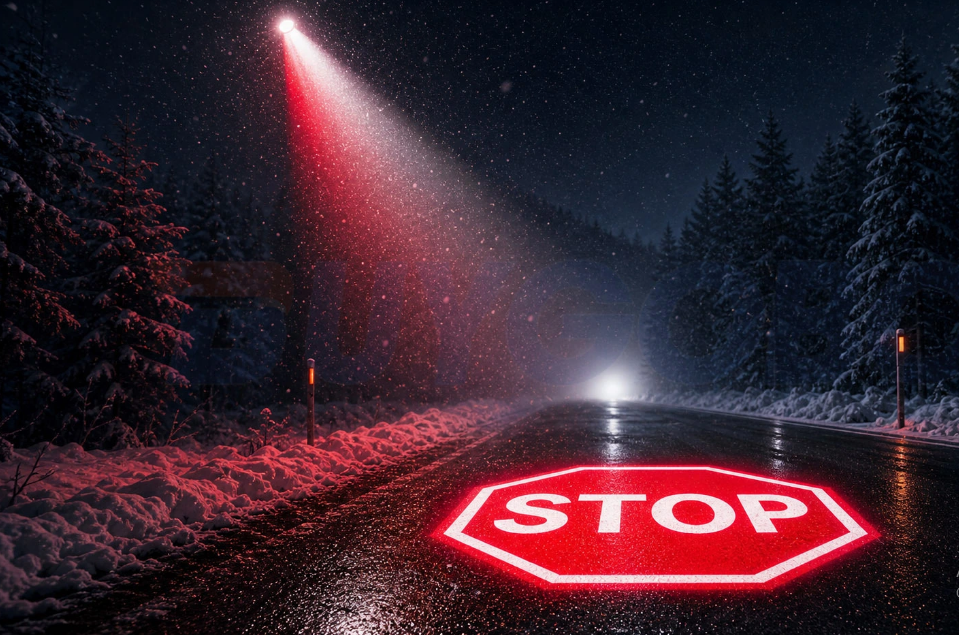
Road safety infrastructure must deliver consistent performance with minimal ongoing maintenance. Noparde built these outdoor road safety projector units specifically to withstand snowy, vibration‑heavy roadside operating conditions, incorporating three core technical features that directly counter the root causes of blurry projected pattern edges:
Patented Anti‑Stick Nano‑Lens Coating Road environments are filled with splashed slush, road salt residue and oily grime — top culprits behind foggy lens surfaces and blurry pattern edges. Noparde’s proprietary anti‑stick nano‑coating allows freezing rain, melted slush and roadway contaminants to slide off the optical glass. This keeps lens surfaces clean in continuous winter operation, preserving crisp symbol outlines and preventing the projected “STOP” sign from growing dim or distorted throughout the cold season.
IP67 Waterproof & Rugged Housing Mounted high on roadside utility poles, the road safety projector features fully sealed construction. It stands up to heavy blizzards, heavy downpours and corrosive road‑salt vapour thrown up by passing traffic. Complete sealing prevents frost, condensation and moisture from forming inside the optical chamber; internal condensation is another frequently overlooked source of soft, blurry projected pattern edges in cold‑climate outdoor installations.
Precision‑Calibrated Focus‑Locked Optical Assembly Vibration generated by passing trucks can slowly shift focus on generic projection hardware, gradually softening graphic borders over weeks of operation. Noparde’s focus‑locked optics resist vibration‑induced drift, maintaining sharp pattern edges long‑term without repeated on‑site tuning by technicians. This addresses one more real‑world answer to the question: What usually causes blurry edges of projected patterns? — slow focus shift driven by continuous roadside mechanical vibration.
After the road safety projector solution went live, municipal officers observed measurable changes in driver behaviour across the intersection. Vehicle braking points became far more predictable, and near‑miss occurrences near the railway crossing dropped significantly.
By replacing weather‑vulnerable road paint with high‑power projection, the municipality obtained a durable, low‑waste safety asset. It requires no repainting work, remains unaffected by snowplough operations, and maintains legible traffic alerts even amid the harshest winter weather. This project also illustrates an important industry takeaway for outdoor safety projection: raw lumen output is only half the requirement. To deliver functional safety signage, you must also mitigate all factors that create blurry edges of projected patterns — lens fouling, internal condensation, vibration‑related focus drift and mismatched lens‑to‑throw‑distance setups. Without controlling these variables, even bright projection hardware will fail to deliver reliable road safety performance.
About Noparde
Noparde is a premier global brand operated by Shenzhen Aladdin Lighting Technology Co., Ltd. Specializing in custom gobo projectors, industrial safety projection, and large‑scale municipal engineering lights, Noparde serves over 200,000 users across 50+ countries, delivering reliable, all‑weather engineering that makes urban roadways and commercial spaces safer.